A copied passage can read smoothly and still differ from its source. A changed name, a reversed number, or a missing “not” may produce an ordinary-looking sentence. Checking whether the text makes sense is therefore different from checking whether you copied it accurately.
For an untimed review after copy-typing practice, use two passes: first check that all the source material is present in the right order, then compare the wording and characters. Keep the source beside the copy throughout.
Establish what the exercise expects
Read the instructions before judging differences. Does the task require exact wording and punctuation? Are paragraph breaks important? Is a line-ending hyphen part of the word, or only a result of the original page layout?
Transcription projects can set different formatting rules. The U.S. National Archives, for example, asks volunteers to preserve original words, capitalization and punctuation while placing less emphasis on matching the document's formatting. That is its project guidance, not a universal scoring rule for typing tests.
For your own practice, choose a short, clearly readable passage and state the rule: copy its words, numbers, capitalization and punctuation without rewriting. If an assessment supplies its own rules, follow those instead. Do this review afterward rather than changing how a timed assessment is conducted.
Keep the first attempt available
Save the original typed attempt before making corrections. Work on a separate copy or record the differences first. Otherwise, a corrected passage may hide the very errors you wanted to understand.
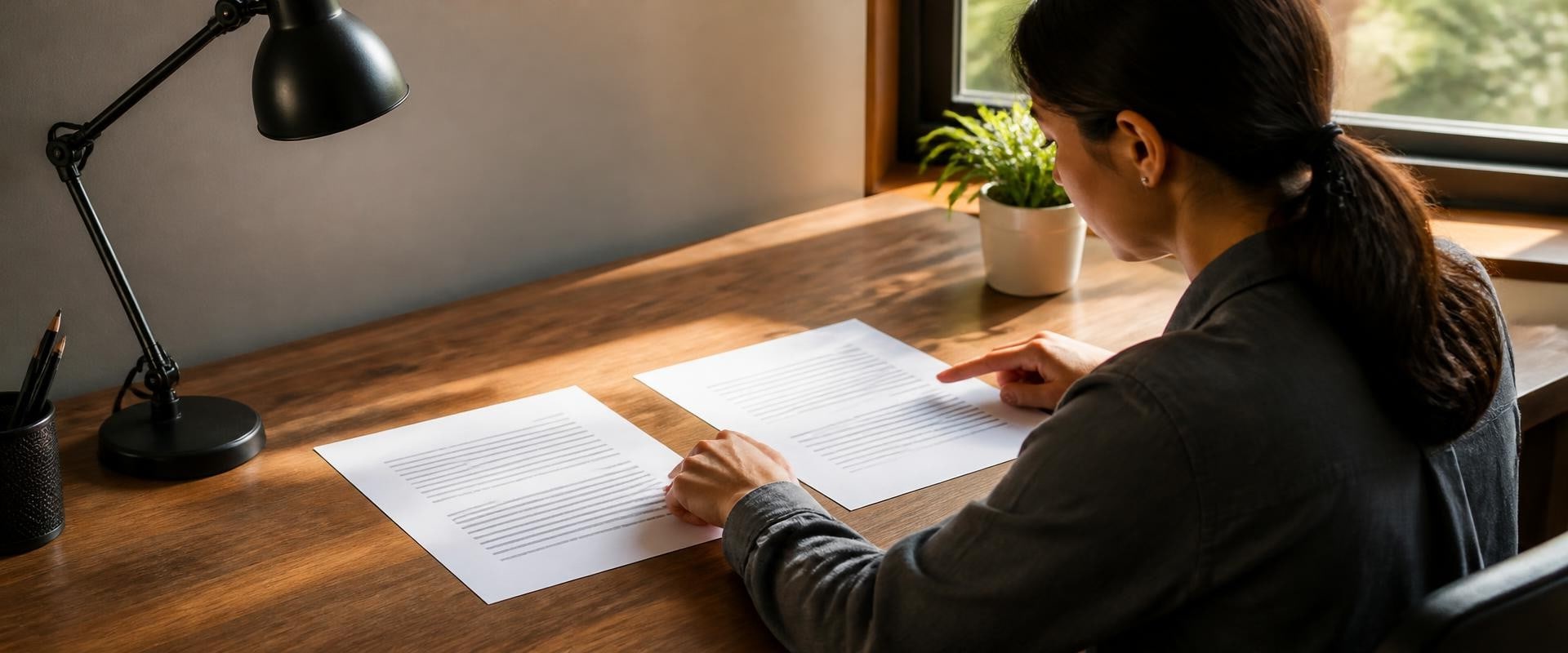
Give the source and attempt clear labels so you do not accidentally edit the source to agree with your copy. Position them side by side or one above the other at a readable size. They do not need identical page layouts, but you should be able to locate the same sentence in both.
First pass: check coverage and sequence
Compare the beginning and end of each paragraph, then follow the sentences between them. Confirm that headings, short standalone lines and list entries were not skipped. Look for repeated text as well as missing text.
Use a pointer or a temporary mark in your review notes to track the section you have completed. If the source and copy wrap lines differently, follow the words rather than assuming that their third screen lines correspond.
Do not stop at matching paragraph counts. One paragraph can contain an omitted sentence, a repeated phrase or a swapped pair of lines. The coverage pass checks the sequence inside each section.
Second pass: compare the actual wording
Work through corresponding short stretches without supplying the next words from memory. Check names, quantities, labels, small connecting words and negatives directly against the source. Then check capitalization, punctuation and spacing according to the exercise's instructions.
The Smithsonian Transcription Center's review guidance calls for reading the entire transcript while comparing it with the original. Its approach is a useful reminder that a review needs both texts, not merely a fresh read of the copy.
Correct spelling alone cannot establish an accurate copy. Mina and Nina are both possible names; 14 and 41 are both valid numbers. Only the source tells you which belongs in this passage.
Try the two passes on a short example
This source and attempted copy are original fictional practice text. The labels below are not part of the passage.
Source:
On Friday, Mina will bring 14 blue folders to Room B12. Keep two blank labels beside the box. Do not place the spare labels inside the folders. Leave the final folder on the lower shelf.
Attempted copy:
On Friday, Nina will bring 41 blue folders to Room B12. Do place the spare labels inside the folders. Leave the final folder on the lower shelf.
The coverage pass finds that the sentence about two blank labels is missing. The character-and-word pass finds three further discrepancies:
- Mina became Nina.
- 14 became 41.
- The word not disappeared from the instruction about spare labels.
The last sentence matches, but that does not make the whole paragraph accurate. Restore the omitted sentence in its proper position, correct the name and number, and restore not. Then compare the whole corrected paragraph with the source again.
These are four review findings, not a claim about how a particular typing platform counts errors. A missing sentence and one substituted character need different descriptions even if a score compresses them into one percentage.
Leave uncertainty visible and choose a focused next step
If a source character is unclear, mark the location as unresolved in a separate note instead of guessing a plausible replacement. For informal practice, a clearer source is more useful than silently inventing text. For assigned work, ask how that uncertainty should be recorded.
If the source appears to contain a mistake, follow the copying instructions and raise the suspected mistake separately. Improving the prose is a different task from making a faithful copy.
Finish with a concrete observation, such as “I skipped one sentence between two similar instructions,” rather than “I am inaccurate.” Keep the original attempt, corrected copy and short error note. Use the next practice passage to pay attention to that specific issue without treating one attempt as a lasting measure of your ability.